

India spends about 0.64% of its GDP on research and development. China spends 2.4%. The US spends 3.5%. Israel spends over 5%.
Now the part that actually stings. Of that 0.64%, the government pays 64% and private industry pays 36%. In Korea, Japan and most of the OECD, business pays around 70%. So it isn’t just that India spends little on R&D. It’s that Indian companies have quietly outsourced the job to the state. The national R&D bill is a government bill, and industry shows up for the photo.
Compare the scale honestly. India’s total R&D spend is somewhere around $15-18 billion a year, across every lab, every university, every company and every ministry. Tesla alone spent $6.4 billion on R&D in 2025, up 41% from the year before. One car company. Roughly a third of what an entire country of 1.4 billion people spends on inventing things.
That’s the first sentence of this argument, and it’s why Indian industry cannot dominate anything.
The car that flips is the same story, told backwards
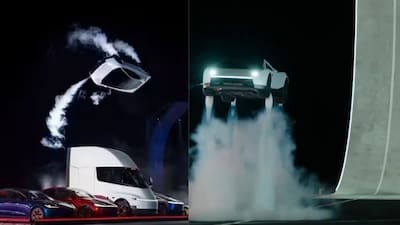
Few Days back, Tesla showed a video of the new Roadster flipping over midair and landing on its wheels. It’s the spectacle Musk has always been good at. The car won’t be on public roads for years, needs regulator approval in multiple states, and Tesla itself won’t say whether it will ever be street-legal. You can put down an order on the website today, and the fine print says there’s no guarantee it will be built, or when.
Read carefully, that isn’t a contradiction of the 2018 story. It’s the same story told backwards.
In 2018 Tesla tried to skip a manufacturing problem and paid for it in depreciation. In 2026 it is spending on an R&D programme whose commercial payoff sits years out, possibly never, and it has ten years of shipped cars behind it to fund the detour. The flip is only possible because the boring part got done first. A company that had never built a car at volume would not be flipping one.
So the real Tesla lesson isn’t “automate less” or “automate more”. It’s:
The caprice and the research get funded by having finished breakfast. You earn the right to work on the flamboyant problem by having solved the unglamorous one first.
That’s the part Indian capital keeps skipping. Not the spending. The order.
India doesn’t have a capital shortage. Private corporate capex for listed firms grew 11% in 2025-26. Gross fixed capital formation runs around 30% of nominal GDP. The money exists and it’s moving. The MoSPI CAPEX survey found about 49.6% of enterprises invested mainly for income generation, 30.1% for upgradation, and 2.8% for diversification. So the answer to “why isn’t Indian capital building things” isn’t “there’s no capital”. It’s where the capital gets pointed.
Investors are buying consumption, not capability
Here’s where the money actually goes. Of all venture capital deployed in India in 2025, core deep tech (space, materials, advanced hardware) took under 5%. Consumer internet and commerce took around 15%, and with fintech taking another 18%, the overwhelming majority of risk capital chased businesses whose core innovation was distribution, discount and delivery speed.
Nobody’s confused about why. A direct-to-consumer brand can show you ₹10 crore of revenue in eighteen months. A materials lab or a battery chemistry programme eats five to ten years before it earns a rupee. If you’re a fund answering to LPs on a seven-year cycle, the consumer brand is the rational bet every single time.
But rational for one fund compounds into irrational for a country. When every rupee of risk capital goes to businesses that monetise consumption, you end up with an economy that has learned to sell things to people without ever learning to make things that people can’t get anywhere else. You built a beautiful pipe. Nothing went in it.
Consumption is downstream of income. You can’t have a growing market of people buying premium ice cream and ten-minute groceries unless something upstream is paying enough people enough money to buy any of it. The consumption economy is not a foundation. It’s a tax on whatever foundation already exists, and India hasn’t built the foundation.

Zepto crossed positive contribution margin in 2025. It’s still not value investing.
I’ll give the quick-commerce case its due. Zepto reaching positive contribution margin at company level in 2025 was a real achievement. It took years of funded losses and a specific sequence: high repeat frequency, dense urban customers, and enormous capital raised at valuations assuming everything would go right.
But there’s a bill nobody prints. On 31 December 2025, thousands of delivery workers across Zomato, Swiggy, Blinkit, Zepto and Flipkart struck on one of the busiest days of the year. Unions including IFAT, TGPWU and the women-led GIPSWU listed declining real earnings after costs, unsafe ten-minute delivery targets, no social security or health cover, and algorithm-driven penalties. Their demands were specific: a per-kilometre rate, a ₹40,000 minimum monthly income, maternity leave, and removal of the ultra-fast guarantees entirely.
The ten-minute promise is not free. It was priced into somebody’s knee, somebody’s fuel bill, and somebody’s accident risk, and that person has no equity in the outcome. A business model that manufactures demand with discounts and fulfils it with people paid per drop hasn’t created a market. It bought one, on credit, with someone else’s time.
That’s the difference between value investing and consumption investing. Consumption investing asks: how fast can I make this number grow?
Value investing asks:
What would still be true about this business if the subsidy disappeared, the riders unionised, and capital got expensive?
Then there’s Tesla, and this is what India skips
Let’s leave the hero worship aside and look at what Tesla actually does.
Tesla spends $6.4 billion a year on R&D and takes bets that cannot pay off on a fund’s timeline. Full self-driving. The Optimus humanoid robot, where Musk claims a $30,000 unit cost that only works at millions of units produced, against several hundred built so far and no general release before 2027. And the new Roadster, which Tesla demonstrated by showing a video of the car flipping midair and landing on its wheels. It won’t be on public roads for years, needs regulator approval across multiple states, and Tesla won’t confirm it’ll ever be street legal. The reservation page’s fine print admits there’s no guarantee it will be built, or when.
None of that has commercial value yet. That’s the point.
Now the part nobody learns when they copy the spectacle. Tesla didn’t start at the Roadster. In 2018, Bernstein’s analysts found the company had spent roughly twice what a normal carmaker spends per unit of capacity to automate final assembly, and it was a reason the Model 3 line couldn’t scale. Tesla paid full price for a shortcut. Then it went back and solved the boring things: process, production, cells, cost per kilowatt-hour. The flamboyant bets only exist because the unglamorous ones got funded first.
And Tesla doesn’t do R&D alone. Panasonic on battery cells. NVIDIA on compute for Autopilot. A $16.5 billion Samsung contract for AI6 silicon at the Taylor fab through 2033, plus TSMC in Arizona. When Tesla can’t build something alone, it buys a decade of somebody else’s capability instead of pretending to invent it.
Tesla took the dare. India’s industry took the discount route.
What you’d actually need to believe
The claims in this piece are testable. Look at your own company, and look at any Indian company you admire.
- Does the R&D line exist? Not a marketing budget, not a design refresh, not a licence fee paid to a foreign parent. A line in the P&L that buys capability. If Indian industry funds only 36% of national R&D, most of those lines are rounding errors.
- Would you fund it if the payoff arrived after your fund’s life? Tesla’s R&D shows up in revenue years later, which is why it needed to sell millions of cars first. Indian capital has no equivalent engine, so it defaults to the eighteen-month number.
- Would your business survive its own profit model? Strip the discount. Let the riders organise. Raise the cost of capital. Whatever’s left is the value. Everything above it was marketing spend wearing a business plan.
- Are you partnering for capability or buying visibility? Tesla partners with Samsung to get silicon it can’t make. Most Indian “strategic partnerships” buy distribution, shelf space or a celebrity face.
Questions about value, we need to ask
- Can Indian companies create products like “How you can build a 50km road in 5 days?” Because infrastructure is problem and solving the this issue will add value to every indians life.
- Can we focus on solutions to preserve Rain water and be sustainable?
- Can Indian companies build products which makes lives of general public easier and happier?
- How can we increase our agricultural out and produce more and sell more to the world?
Yes, there are companies who are working towards real problems, but I feel still they are not appreciated enough or they are under funded. Investors are increasingly supporting “Consumer based businesses” with no real and long term value.
That’s the Truth and happenings around us.
The dare
India doesn’t have a capital problem. Private corporate capex for listed firms grew 11% in 2025-26, and gross fixed capital formation sits near 30% of nominal GDP. The money exists and it’s moving. It’s moving toward consumption because consumption returns fast and answers to nobody.
That’s the trap. Not that Indian companies are lazy. That they’re rational in a system that punishes the long bet, and the long bet is the only one that ends in dominance.
Tesla proved you cannot skip the hard part. It also proved you can eventually reach the impossible part if you don’t.
The difference between India and Tesla isn’t talent or money or even time. It’s the willingness to spend a decade on something with no commercial value yet.
Tesla took the dare. India is still deciding what to buy.
