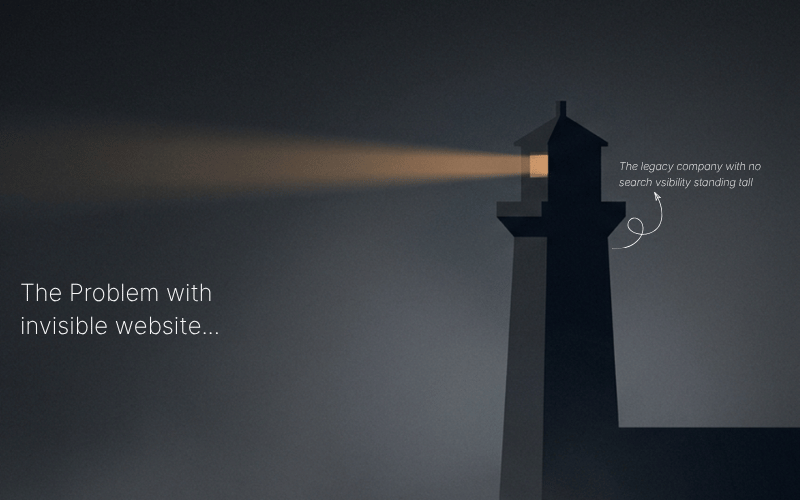
Most manufacturer websites aren’t bad. Nobody visits them and thinks, “this is terrible.” They think nothing at all.
The site sits there. It lists products. It has a logo. A brochure PDF from 2019. Every week, your ideal customer types your exact product into Google, clicks a competitor, and never knows you existed.
That’s not a design problem.
We build websites for B2B manufacturers around how your buyers actually search and buy, not how a template looks in a portfolio. Three things, in order.
Position first. One sentence that says who you serve and why you win with them. Not “quality products and great service.” If it could sit on any competitor’s homepage unchanged, it isn’t positioning yet, and everything else we build will inherit that blur.
Then proof. B2B buyers don’t want claims. They want evidence they can carry into a meeting with their boss. The case study, the client name, the spec, the number. We structure your site so the proof is findable in seconds, not buried in a PDF nobody opens.
Then presence. Deliberate, manual development around the searches that matter in your category. Google, AI answers, reviews, the threads your buyers actually read. Consistency over volume. You don’t need to be loud. You need to be there.
AI is a tool here, not a strategy. AI is genuinely useful for drafting copy, generating variations, and speeding up the boring 60%. It can fill pages. It cannot decide what deserves to be findable, choose your positioning sentence, or wire your content to the searches your buyers use. Those decisions come from knowing your buyers: the objections on every call, the competitor you lose against and why, what procurement asks in the second meeting.
A beautiful homepage nobody finds is still an invisible website. You’ve polished a room nobody walks into.